From Policy Memo to Public-Facing Form
A policy memo to public-facing form should preserve the decision while making each action clear, so people can complete the process without guessing.
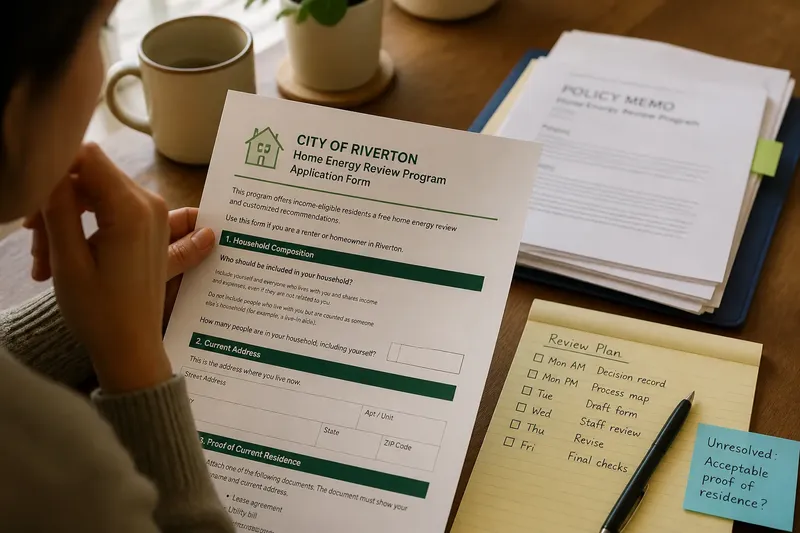
A resident opens a city benefits form at the kitchen table, finds a question about “household composition,” and stops. The policy memo may define that term precisely, but the form has to help a person decide what to enter and what to do next. Turning a policy memo to public-facing form is delivery work: the decision must survive translation into clear instructions, a usable sequence, and a process staff can administer.
A good translation does not simply replace official words with simpler ones. It connects each requirement to an action, explains what information is needed, and shows what happens after submission. A focused review over one working week can uncover gaps before a new form reaches the public. The schedule below gives policy, program, communications, and service staff distinct work to do without losing sight of the people who will use the form.
Start with the decision
On Monday morning, gather the approved policy memo, any adopted rules, existing forms, and the instructions staff currently use. Identify one policy owner who can answer questions about what the decision means. Do not begin by polishing sentences. First establish what the public must be able to do and what the agency must decide.
Make a compact decision record with four parts:
- Purpose: What public action or service does the policy establish?
- Eligibility: Who may apply, participate, or be affected?
- Requirements: What must a person provide or do, and which requirements are mandatory?
- Agency response: What does staff review, and what outcome or next communication follows?
For each requirement, point to the source in the memo or governing rule. Mark any matter that is still undecided. A draft form should not quietly settle an open policy question; doing so can create inconsistent treatment and make later corrections harder.
Separate the policy decision from the method used to carry it out. If a memo says applicants must establish current residence, the policy owner should clarify what evidence is acceptable and how staff handle a document that does not fit the usual pattern. The form team should not invent a narrow evidence rule simply because it is easier to express in a checkbox.
Map the public journey
By Monday afternoon, write the process from the resident’s point of view, beginning before the form is opened. A person may first hear about a program through a library flyer, a school office, a city website, or a phone call. The route should explain where to get the form, what to prepare, how to submit it, and how to ask for help.
Keep the map concrete. For each stage, note the public’s action, the information or material needed, the agency’s action, and the next event the person should expect. This exposes missing handoffs. A form may ask for a supporting document without saying how to provide it. A confirmation may arrive without telling the applicant whether the submission is complete or merely received.
Imagine a city program that offers a home energy review after a resident submits an application and proof of address. The memo requires proof of current residence but does not say which documents count. The team records that ambiguity, asks the policy owner to resolve it, and only then drafts a prompt that names acceptable document types and offers a route for someone whose situation differs. The expected observable result is that applicants can choose a suitable document or ask for an alternative, rather than guessing what the agency will accept.
Map more than the ideal route. Include common interruptions: a person has no printer, cannot upload a file, submits an incomplete form, or needs to correct an answer. For each interruption, identify a real contact point or next action. If the route depends on a service the agency does not provide, do not imply that it does.
Draft in action order
On Tuesday, arrange the form in the order a person can complete it. Start with a short explanation of the program and a plain statement of who should use the form. Then group related questions: contact details, eligibility, requested service, supporting documents, and confirmation. Put instructions beside the question they explain rather than relying on a distant paragraph.
Use labels that help people answer. “Current address” is usually more usable than an unexplained administrative term. If a policy term must remain, define it at the point of use and give a concrete boundary. A question about household members, for example, should say whom to include and whether the applicant should include themselves, if those details follow the policy.
Make the next action visible. If a person must attach a document, say which document types are accepted, what information should remain visible, and how to submit it. If an answer is optional, mark it as optional and explain why the agency asks for it when that reason affects a person’s choice. Avoid using a required-field symbol without defining it.
Review every instruction for a single clear task. “Complete and return this application with the required information and documentation” bundles several actions and leaves “required” unexplained. A sequence of short directions can be easier to follow: complete the marked sections, attach one acceptable proof of address, and submit the form using one of the listed methods. The actual options must match the agency’s process.
For digital forms, check that the sequence still works on a phone. Long dropdown lists, unclear error messages, and fields that erase a response can undermine plain language. For paper forms, check that answer space is sufficient and that a person can tell which pages or attachments to return. The medium changes the friction; it does not change the policy.
Build a week of review
A short delivery review works best when each day has a defined output. The timetable below is a practical sequence, not a substitute for the agency’s approval process.
- Monday morning: Assemble the memo, rules, current materials, and decision record. The output is a list of settled requirements and unresolved policy questions.
- Monday afternoon: Map the public journey, including access routes, submission, incomplete applications, and follow-up. The output is a process map with named agency handoffs.
- Tuesday: Draft the form and instructions in the order people need them. The output is a complete working draft, including contact details and submission routes.
- Wednesday: Review the draft with program staff and the policy owner. The output is a set of corrections that distinguish policy requirements from administrative preferences.
- Thursday: Ask people unfamiliar with the draft to complete realistic tasks while a facilitator observes. The output is a log of where they pause, misread a prompt, or cannot identify the next step.
- Friday: Resolve issues, check the revised form against the decision record, and prepare staff-facing guidance. The output is an approved or clearly marked draft with outstanding decisions assigned to an owner.
Leave time between review and release for changes that alter meaning. A last-minute wording edit can change who appears eligible or what evidence seems acceptable. Route those edits back to the policy owner rather than treating them as copyediting.
Check meaning and sequence?
What should a form say first?
Start with the purpose, intended user, and action the person is being asked to take. That opening helps someone decide whether to continue before encountering detailed questions.
How can staff test an instruction?
Give a reviewer a specific task and let them work without coaching. Ask what they think a question means and what they expect to happen after they submit; record the point of confusion, not just their general reaction.
Should a form explain a rejection?
It should tell people what happens if information is missing or a requirement is not met, using the agency’s actual process. Where a decision can be reconsidered or corrected, name the appropriate route and contact point.
What belongs in staff guidance?
Include how to handle incomplete submissions, unusual documents, accessibility requests, and questions the form cannot answer. Staff guidance should follow the same policy interpretation as the public form, not introduce a separate set of rules.
Review with real tasks
On Thursday, do not ask reviewers whether the form “looks clear.” Ask them to perform a task, such as finding out who qualifies or identifying what to attach. Observe whether the order makes sense, whether labels are understood, and whether the person can locate help without being prompted. Invite people with different levels of familiarity with agency language, and offer an accessible format where needed.
Record observations in a simple table: the task, where the person paused, what they thought a phrase meant, and the change the team proposes. Keep the observation separate from interpretation. “Reviewer looked at the document list twice” is an observation; “the list is too long” is a possible explanation. The team can then decide whether the issue is wording, organization, or a policy requirement that needs clarification.
Do not turn a small review into a claim that the form works for everyone. It is a way to catch foreseeable confusion before release. If participants interpret a key requirement in different ways, return to the source decision and settle the meaning before changing the sentence.
Prepare the handoff
On Friday, check the public form and staff guidance side by side. Use the decision record to confirm that each required field has a policy basis, each instruction matches an actual process, and each outcome described to the public can be delivered by the agency. Check that phone numbers, web addresses, office names, and submission methods are current.
Prepare a short staff note for the first day of use. It should identify the form version, explain any changed questions, name the person who owns unresolved interpretations, and state how staff should report a confusing prompt. If an older form remains available at a library or service counter, explain how staff will direct people to the current one.
After release, collect questions that point to a specific barrier: repeated confusion about a term, difficulty attaching a file, or uncertainty about what follows submission. Assign someone to review those signals and determine whether the form, staff guidance, or underlying policy needs attention. A public-facing form is part of a service, not a one-time document; the useful test is whether its words and sequence continue to match the decisions staff actually make.
When translating a policy memo to public-facing form, preserve the decision at every handoff: from the memo to the prompt, from the prompt to the person’s action, and from that action to the agency response. Clear language matters because it makes those handoffs visible. A form that tells people what to do, what the agency needs, and what happens next gives staff a sounder basis for consistent delivery.